Songtrust vs Sentric vs TuneCore Publishing: Which Publishing Administrator Is Right for You?
Comparing Songtrust, Sentric, TuneCore Publishing and Dark Lab: how each type of publishing administrator charges, what you keep, and the eight questions to ask before you sign anything.
On this page
- The key points
- What does a publishing administrator actually do?
- Songtrust, Sentric, TuneCore Publishing and Dark Lab at a glance
- Understanding the fee: what is the percentage applied to?
- Setup fees, terms and how easy it is to leave
- Coverage: which societies and territories are actually registered?
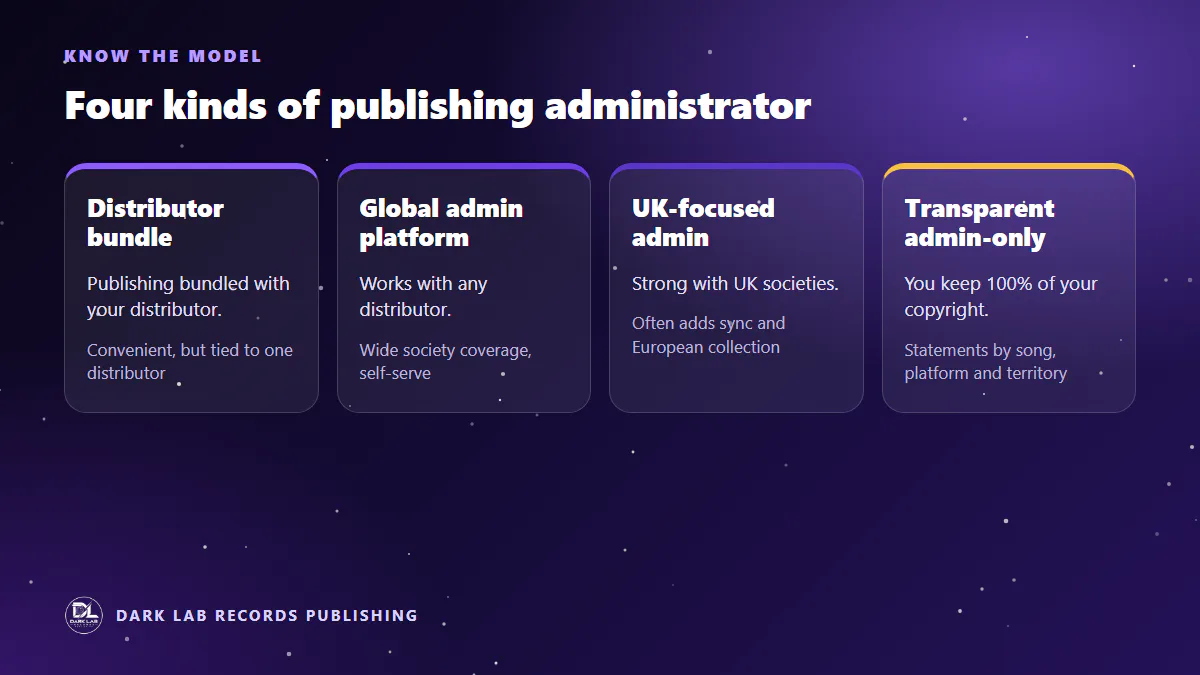
- Bundled with your distributor, or independent?
- Eight questions to ask any publishing administrator
- Red flags in an administration agreement
- Which option suits which writer?
- How Dark Lab Records Publishing approaches administration
- Final thoughts
If you write songs and release music independently, sooner or later you will meet a publishing administrator. The same few names keep coming up: Songtrust, Sentric, TuneCore Publishing and a growing list of newer services. They all promise to collect the royalties you are owed, but they charge in different ways, work with different societies and ask for different commitments. This guide compares the main options in plain English so you can decide what to look for before you sign.
A note on accuracy: prices, commissions and ownership structures in this market change often, and third-party comparison sites do not always agree with each other. Treat everything about other companies below as a starting point and confirm the current terms on each company's own website.
The key points
- A publishing administrator registers your songs and collects publishing royalties around the world. It should not take ownership of your copyright.
- The headline commission is not the full story. Check what the percentage is applied to, whether there is a setup fee, and how long you are tied in.
- A distributor such as DistroKid or TuneCore collects master-recording income. Publishing income for the song is separate and is only collected if you sign up for it.
- The best provider for you depends on where your songs earn, how many writers are involved and how much visibility you want over statements.
What does a publishing administrator actually do?
Every released song contains a composition (the melody and lyrics) and a recording. Streaming services and broadcasters pay for both. The composition income is publishing income. To collect it, each song must be registered with the right collecting societies in each territory, with correct writers, splits and identifiers. A publishing administrator takes that job off your hands and chases the money, usually for a commission. If you want the fundamentals first, read our guide to music publishing administration and our explanation of what a music publisher does.
Administration is different from a full publishing deal. An administrator handles paperwork and collection. A full publisher usually takes a share of ownership and tries to find you opportunities. We explain the difference in admin vs co-publishing vs full publishing.
Songtrust, Sentric, TuneCore Publishing and Dark Lab at a glance
The table below summarises how each is generally described. Figures marked "reported" come from third-party comparisons and are not guaranteed.
| Provider | Generally known for | How it charges (reported) | Ownership of your songs |
|---|---|---|---|
| Songtrust | Works with any distributor; broad coverage of collecting societies; strong in the US market | A one-time setup fee per writer plus a commission on royalties collected | Administration only; confirm in the agreement |
| Sentric Music | UK-based; good relationships with UK societies; sync pitching and European collection | A commission on royalties; some comparisons report no up-front fee | Administration only; confirm in the agreement |
| TuneCore Publishing | Convenient if you already distribute with TuneCore; described by comparison sites as run by Sentric | A setup fee plus a commission, reported as taken from the publisher's share | Administration only; confirm in the agreement |
| Dark Lab Records Publishing | UK-registered company with a team in London and Vancouver; registration and collection across 200+ territories; statements by song, DSP and territory | Ask the team for current terms | You keep 100% of your copyright. Administration only, with no advance or exclusive creative deal |
Understanding the fee: what is the percentage applied to?
Two services can both say "20%" and mean very different things. A performance royalty is conventionally split into two halves: the writer's share and the publisher's share. (We explain this in detail in writer's share vs publisher's share.)
- If an administrator takes 20% of everything it collects on a £100 royalty, it keeps £20.
- If it takes 20% of the publisher's half only, it keeps 20% of £50, which is £10, and the writer's £50 is paid to you directly by your society.
The headline percentage is the same, but the real cost is half as much in the second case. Always ask for the calculation using a £100 example. Also check whether the commission is applied to every income type (performance, mechanical, micro-sync) or only some, and whether there are separate fees for registrations or payments.
Setup fees, terms and how easy it is to leave
A setup fee is not automatically bad, but it should buy something you can see. The more important question is the term: how long you are committed and how you can end the agreement. Look for:
- the length of the initial term and any automatic renewal;
- the notice period for leaving;
- whether the administrator keeps collecting on your existing registrations after you leave, and for how long;
- whether you can export your registration data and statements in a usable format.
Coverage: which societies and territories are actually registered?
Publishing money is collected by societies in many countries. A provider can only collect where it is registered, so ask which societies it works with and whether it covers the territories where your audience actually is. Dark Lab Records Publishing, for example, states registration and royalty collection across more than 200 territories. A UK-based administrator should also register your works correctly with PRS for Music and MCPS (see PRS vs MCPS vs PPL).
Bundled with your distributor, or independent?
Some distributors offer publishing as an add-on. It is convenient because everything sits in one place, but it ties your publishing to your distributor. If you ever move distributor, you may have to move your publishing too. An independent administrator works with any distributor, which gives you more freedom. Neither is wrong, but you should choose on purpose rather than by default.
Eight questions to ask any publishing administrator
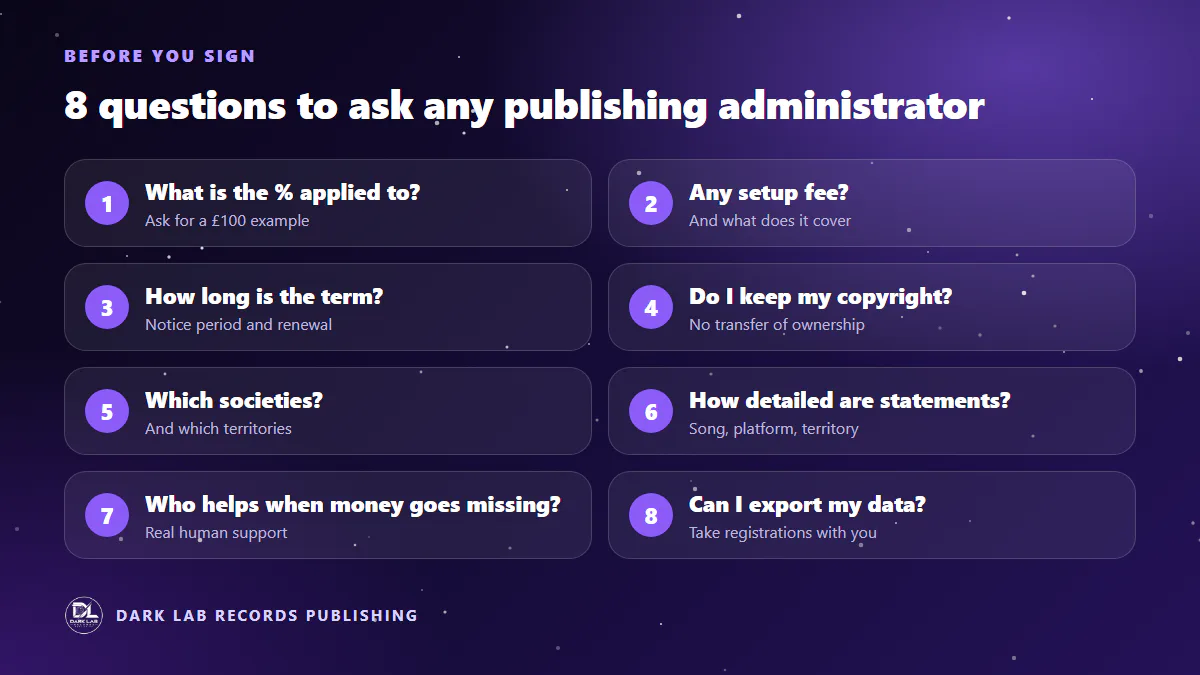
- What exactly is the commission applied to? Ask for a £100 worked example.
- Is there a setup fee, and what does it cover?
- How long is the term and how do I leave?
- Do I keep 100% of my copyright? There should be no transfer of ownership.
- Which societies and territories do you register with?
- How detailed are statements? Look for earnings by song, platform and territory.
- Who do I speak to when royalties go missing? Check for real human support.
- Can I export my data? You should be able to take your registrations with you.
Red flags in an administration agreement
- Wording that assigns or transfers copyright when you only asked for administration.
- A long, automatically renewing term with no clear way to leave.
- Commission applied to income you could already collect yourself without any work from the administrator.
- No statements, or statements without song, platform and territory detail.
- Promises of guaranteed income or "up to 50% more royalties". Nobody can guarantee what your songs will earn.
Which option suits which writer?
- UK-based writer with a UK audience: prioritise a provider that registers properly with PRS for Music and MCPS and reaches overseas societies.
- Writer with a mostly US audience: check how The MLC and US performing rights organisations are handled.
- Artist already on a distributor's publishing add-on: compare its terms with an independent administrator before deciding.
- Label, publisher or catalogue owner: look for multi-writer statements and exports. See our page for labels and publishers.
How Dark Lab Records Publishing approaches administration
Dark Lab is built around three principles: you keep 100% of your copyright, administration only (we never ask you to assign your songs), and statements you can actually read. You add your songs and writers in the dashboard, we register and administer them, and you see earnings by song, platform and territory, with exports to PDF, Excel or CSV. If you want to talk through your catalogue first, see how it works or contact the team.
Final thoughts
There is no single best publishing administrator, only the one whose terms you understand and whose service fits your catalogue. Compare at least two, ask the eight questions above, and never sign anything that transfers ownership of your songs when all you wanted was collection. Not sure whether you already have unclaimed money? Start with our guide to black box royalties.
Frequently asked questions
Is Songtrust better than Sentric?
Neither is better for everyone. Songtrust is widely described as a platform that works with any distributor and covers a large number of societies, while Sentric is UK-based and often recommended to UK writers who want sync and European collection. The right choice depends on where your income comes from, how the fee is charged and how easily you can leave.
Do I still need a publishing administrator if I use DistroKid or TuneCore?
Usually yes. Distributors mainly collect the master-recording income from streaming services. Publishing royalties for the song itself are a separate income that a distributor only collects if you switch on its publishing add-on. If you have not, those royalties may be sitting unclaimed.
How much does a publishing administrator charge?
Models vary: a commission on royalties collected, a one-time setup fee per writer plus a commission, or a commission taken only from the publisher's half. Third-party comparisons report different figures for the same company, so always read the provider's current terms and ask what the percentage is applied to.
Will a publishing administrator own my songs?
A genuine administration deal should not transfer your copyright. You should keep ownership and the administrator should only act on your behalf for a period of time. Always check the contract for any assignment of rights.
Can I switch publishing administrator later?
Yes, but check the term and notice period first. Some agreements renew automatically or keep collecting on your registrations for a time after you leave. Ask what happens to your registered data and to royalties in the pipeline.
Which publishing administrator is best for UK songwriters?
Look for one that registers with PRS for Music and MCPS properly and also reaches overseas societies. Compare UK-focused administrators and global platforms on fees, term and statements, and choose the one whose terms you fully understand.
Written by
Dark Lab Records Publishing
Practical guidance on music publishing, royalties and rights from the Dark Lab Records Publishing team.