ISRC vs ISWC vs IPI: The Music Codes Every Songwriter Needs to Know
ISRC identifies a recording, ISWC identifies a song and IPI identifies a person. Learn what each code does, where to get it and how missing or mismatched codes stop royalties from reaching you.
On this page
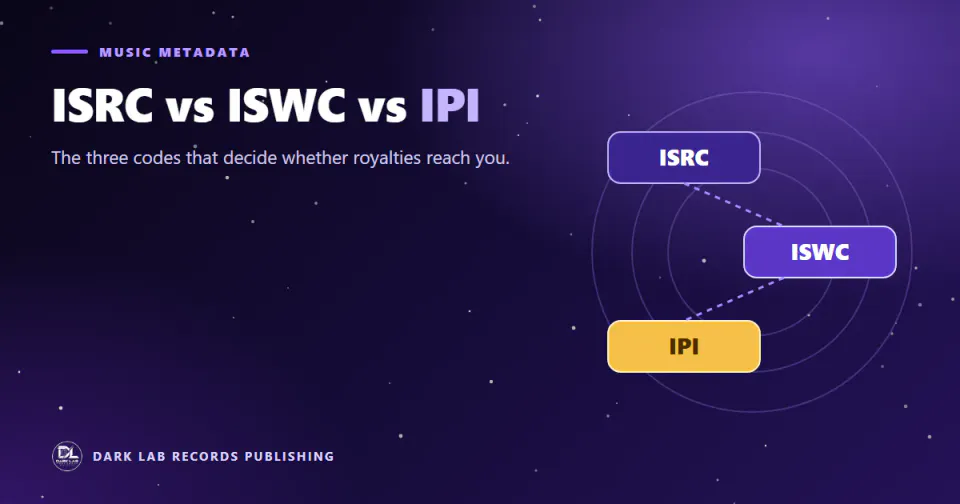
Behind every royalty payment is a trail of codes. Three of them cause most of the confusion for songwriters and independent artists: the ISRC, the ISWC and the IPI. They look like random strings of letters and numbers, but together they are how streaming services, societies and publishers work out which recording is which song and who should be paid. When these codes are missing or do not match, money gets stuck. This guide explains each one in plain English.
The short answer
- ISRC (International Standard Recording Code) identifies a recording.
- ISWC (International Standard Musical Work Code) identifies the song itself.
- IPI (Interested Party Information) identifies a person or company with a stake in the song.
What is an ISRC?
An ISRC is a unique code for one specific sound recording, like a fingerprint for the master. If you release a studio version, a live version and a remix, each gets its own ISRC. Your distributor or label normally assigns it when you release the track, and it stays with that recording for life. Streaming services use the ISRC to count plays and pay the owner of the master. You can find more about the ISRC system at the IFPI ISRC site.
What is an ISWC?
An ISWC identifies the composition: the melody and lyrics, regardless of who records it. It always begins with the letter T followed by digits. A song keeps the same ISWC no matter how many times it is recorded, covered or remixed. Societies use it to link all the recordings of a work to one registration, so the writers are paid correctly. The ISWC is allocated when a work is registered with a collecting society, and you can learn more at ISWC Net.
What is an IPI number?
An IPI number identifies a person or company: a songwriter, composer, lyricist or publisher. It is how societies tell apart two writers with the same name and make sure each one is paid for the right works. You normally receive an IPI number from your society when you join. Our guide to registering a song, IPI numbers and split sheets shows where it is used in practice.
What the codes look like
- ISRC: 12 characters in four parts: a two-letter country code, a three-character registrant code, a two-digit year and a five-digit designation number, for example
GB-XXX-26-00001(an example format, not a real code). - ISWC: the letter T, nine digits and a check digit, for example
T-123.456.789-0. - IPI: a number of up to eleven digits assigned to the person or company, for example
00123456789.
You do not create these by hand. They are issued by your distributor, your society or the relevant agency, but you should know where to find them.
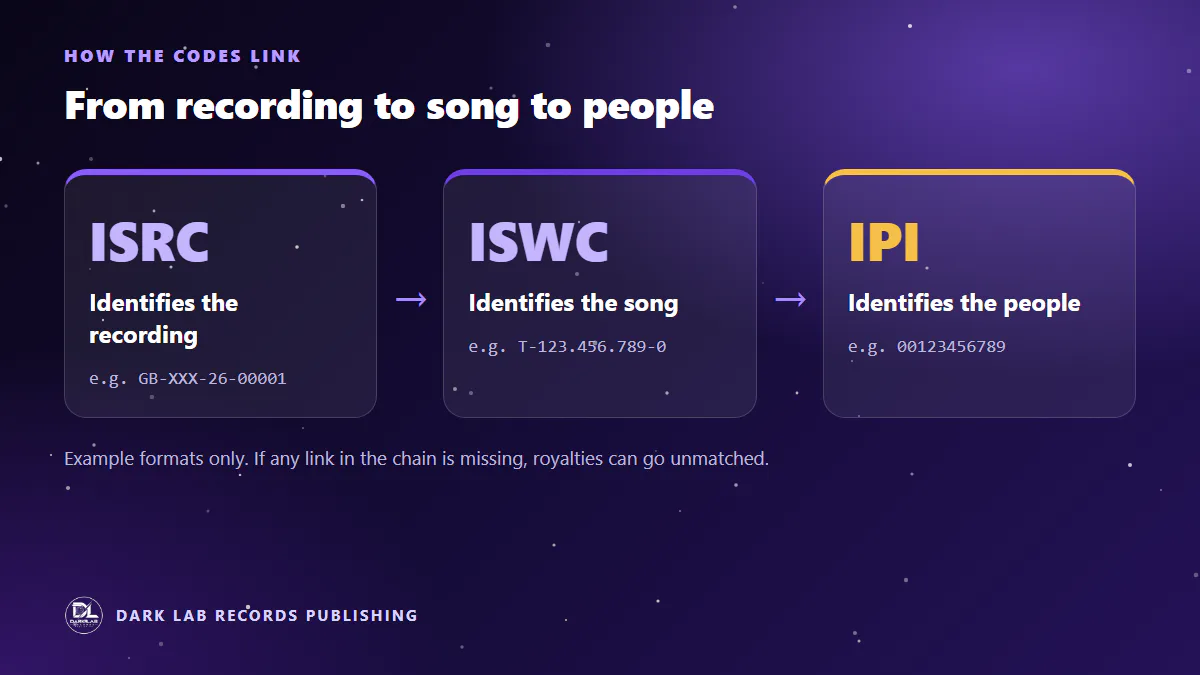
How the three codes fit together
Think of it as a chain:
- A listener plays a recording. The platform reports its ISRC.
- The ISRC is matched to a work with an ISWC.
- The ISWC is linked to the writers and publishers through their IPI numbers and splits.
- Money is divided and paid.
If any link in the chain is missing, the money can stall. This is one of the main reasons royalties become "unmatched" and sit in the pool we describe in black box royalties.
Covers, remixes and re-releases: what changes?
- A new recording of the same song (a cover, a live version, a re-record) gets a new ISRC but keeps the same ISWC, because the song has not changed.
- A remix is a new recording, so it gets its own ISRC. If it adds new melody or lyrics, it may also need its own work registration.
- A re-release of the same recording generally keeps its original ISRC. Only a genuinely new recording should receive a new one.
- A change of distributor should not change your ISRC. If it does, plays can be split across two codes and statements become hard to reconcile.
Other codes you will meet
Release-level codes such as the UPC or EAN barcode identify an album or single as a product, not a song or a recording. ISNI identifies public identities such as artists. They are useful, but they do not replace the ISRC, ISWC and IPI for royalty matching.
Why codes go wrong
- The recording was released but the work was never registered with a society.
- The title or spelling differs between the recording and the registration.
- A writer is missing or the splits do not add up to 100%.
- The same recording has been given more than one ISRC, or two different recordings share one.
- No publisher is attached, so the second half of the royalty has nowhere to go (see writer's share vs publisher's share).
Pre-release metadata checklist
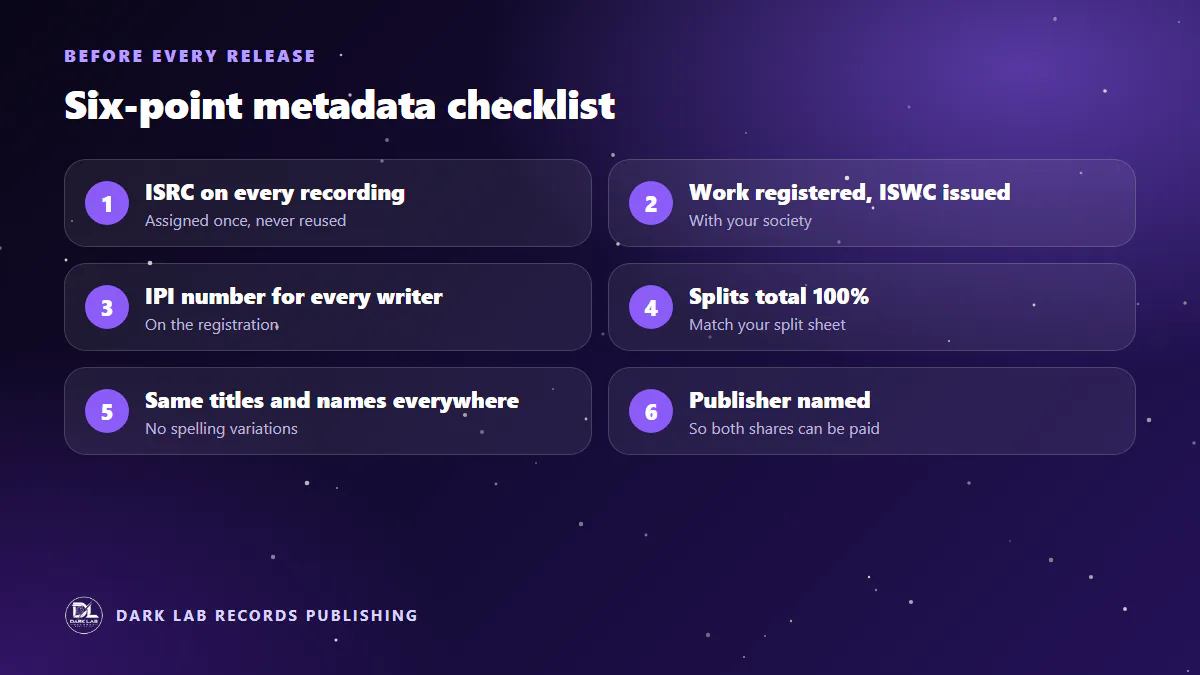
- Every recording has its own ISRC, assigned once and never reused.
- The song is registered with your society, so it has an ISWC.
- Every writer has an IPI number on the registration.
- The splits add up to 100% and match your split sheet.
- The title and writer names are identical everywhere.
- A publisher is named, so both shares of the royalty can be paid.
How to find your own codes
Your ISRCs are on your distributor's release pages. Your ISWCs and IPI number are in your society's member area, for example under your registered works. If your catalogue is large or messy, a publishing administrator can audit it, fix mismatches and register the rest. Dark Lab Records Publishing manages composition registration, writer and rights data and statement reporting in one dashboard, and you keep 100% of your copyright. See how it works, or read more about choosing a publishing administrator.
Final thoughts
You do not need to memorise the codes, but you should know what each one does and check that they exist for every song you release. Get the registrations right before release day and the money has a clear path to you. If you suspect songs are unmatched, start by looking up your works and compare titles, writers and splits against your split sheet.
Frequently asked questions
Is an ISWC the same as an ISRC?
No. An ISRC identifies a specific sound recording (a master). An ISWC identifies the underlying composition (the song). One song can have many recordings, each with its own ISRC, but it keeps a single ISWC.
What is an IPI number?
An IPI (Interested Party Information) number identifies a person or company with an interest in a work, such as a songwriter, composer or publisher. You normally receive one from your collecting society when you join.
Where do I get an ISRC?
Your distributor or label normally assigns ISRCs when you release music. If you issue your own, you apply through the ISRC agency for your country. Never reuse one ISRC for two different recordings.
How do I get an ISWC?
An ISWC is allocated to a composition when it is registered with a collecting society. After you register a work with its writers and splits, the society's data is used to assign or link the ISWC. You can look up your works in your society's member area.
Do I need an ISWC to get paid?
The code itself does not pay you, but it helps systems match a recording to the right composition. If recordings are not matched to a registered work, writers can go unpaid. Correct registration and consistent metadata are what matter most.
Why are some of my songs unmatched?
Common reasons are a missing or wrong work registration, different titles on different platforms, missing writers or incorrect splits, and recordings that were never linked to the work. A publishing administrator can audit your catalogue and fix mismatches.
Written by
Dark Lab Records Publishing
Practical guidance on music publishing, royalties and rights from the Dark Lab Records Publishing team.