Writer's Share vs Publisher's Share: The 50% Many Self-Published Songwriters Never Collect
Every performance royalty has two halves: the writer's share and the publisher's share. If you self-publish and only register as a writer, the second half may never reach you. Here is how to claim both.
On this page
- The key points
- What is the writer's share?
- What is the publisher's share?
- A worked example
- Why self-published writers miss the second half
- How to claim both shares: five steps
- What if there are several writers?
- Does it apply to mechanical and sync income too?
- Signs you might be missing the publisher's share
- Do you need a publishing administrator?
- Final thoughts
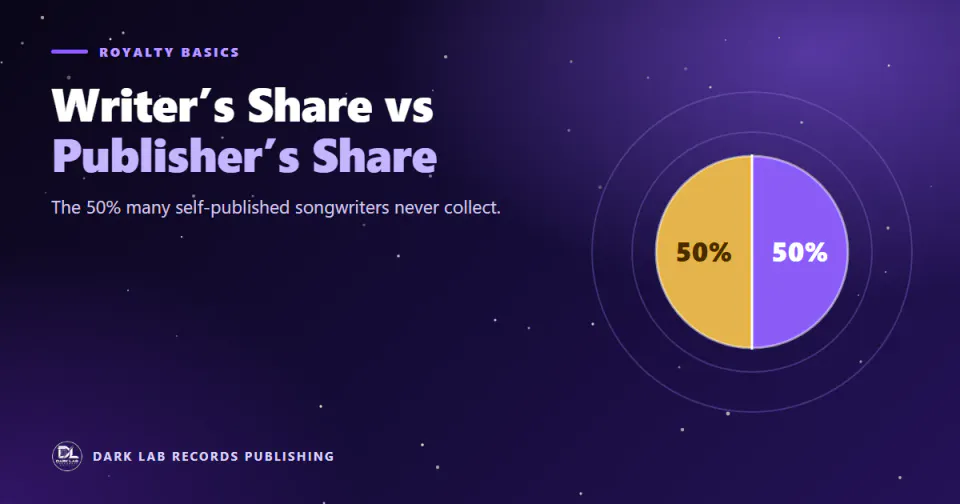
Here is a fact that surprises many independent songwriters: every performance royalty your song earns is conventionally split into two halves. One half belongs to the writer. The other half belongs to the publisher. If you write and release your own music, you are both, so you are entitled to 100%. But collecting societies only pay what they are told to pay, and many self-published writers register themselves as writers only. The publisher's half then has nowhere to go.
This guide explains the difference between the writer's share and the publisher's share, why one of them is so often missed, and the five steps to make sure you collect both.
The key points
- Writer's share: the half of a performance royalty paid to the songwriter(s), usually through a collecting society such as PRS for Music.
- Publisher's share: the other half, paid to whoever is registered as the publisher of the song.
- If you self-publish and only register as a writer, you may be collecting half of what the song earns.
- You can claim the publisher's share by registering a publisher entity with your society or by using a publishing administrator.
What is the writer's share?
The writer's share is the songwriter's personal entitlement. It is paid to the writer through their collecting society, and in most systems it cannot be signed away in a publishing deal. If you are a member of a society such as PRS for Music and your song is registered with the correct splits, the society pays your writer's share to you directly. This is the half most writers know about, because joining a society and registering a song is the first step everyone is told to take (see our walkthrough on how to register a song).
What is the publisher's share?
The publisher's share is the other half. In a traditional deal the publisher keeps part of it as payment for its work and passes the rest on, depending on the contract. In an administration deal the administrator takes only a commission. If you are your own publisher, the publisher's share is simply more money for you, but only if your society knows who the publisher is.
A worked example
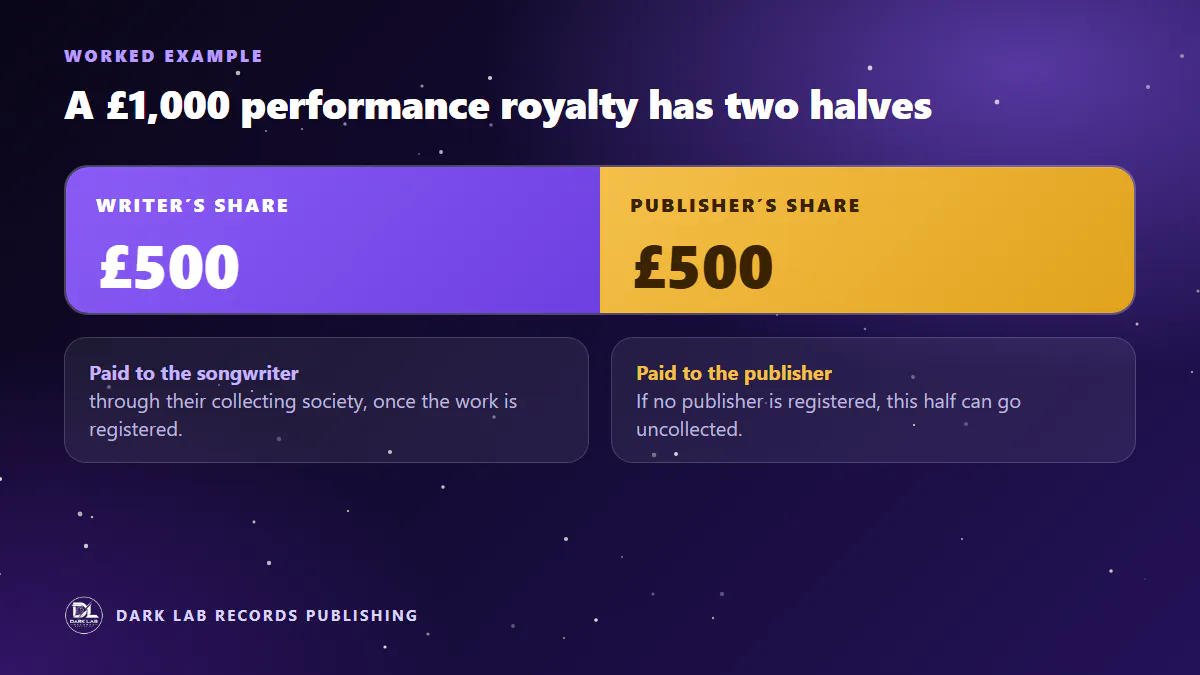
Imagine a song earns £1,000 in performance royalties.
- Writer's share: £500, paid to the songwriter through their society.
- Publisher's share: £500, paid to the publisher of the song.
If you registered the song with yourself as the only writer and no publisher, the society can pay the £500 writer's share. The other £500 has no registered recipient. Over many songs and many years, that gap can grow into a serious amount of money. Part of it may end up in the unallocated pool we describe in black box royalties.
Why self-published writers miss the second half
- Registration forms ask for a writer first. It is easy to stop there and assume the job is done.
- No publisher name is attached. A song registered without a publisher has no one to pay the publisher's share to.
- Distributors collect the master, not the composition. Many writers assume their distributor is handling "everything".
- Different societies, different forms. Mechanical and overseas income each need their own registrations, as we explain in performance, mechanical and sync royalties.
How to claim both shares: five steps
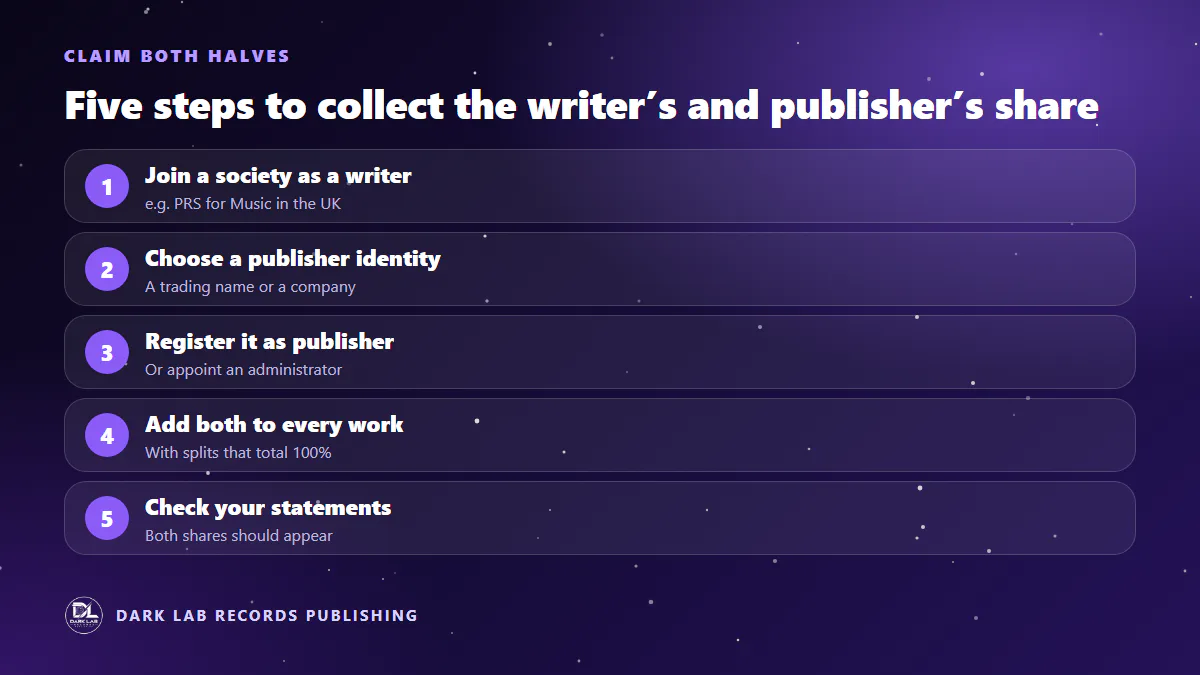
- Join a collecting society as a writer. In the UK that is PRS for Music, where you can also apply for MCPS membership to cover mechanical rights.
- Decide on your publisher identity. This can be a name you trade under or a company. Take proper advice on the right structure for you.
- Register that identity as a publisher, usually with the same society you joined as a writer, or appoint a publishing administrator to collect the publisher's share for you. Societies set their own eligibility rules and fees, so check them directly.
- Add both the writer and the publisher to every work when you register it, together with the correct splits. A split sheet written at the time of writing avoids arguments later.
- Check your statements. Make sure both shares appear, and query any song listed with no publisher or with unmatched income.
What if there are several writers?
The writer's share is divided between the writers according to the splits you agree. Imagine two co-writers who agree a 60/40 split on a song that earns £1,000 in performance royalties. The writer's share is £500, so one writer receives £300 and the other £200. If each writer has their own publishing company, each publisher receives its writer's matching slice of the £500 publisher's share. If one writer has no publisher registered, their slice of the publisher's share stays unclaimed. That is why a signed split sheet matters, and why every writer should have a publisher identity on the registration.
Does it apply to mechanical and sync income too?
The 50/50 convention is most often quoted for performance royalties. Mechanical royalties and sync fees are usually paid to the publisher, who then passes the writer's part on under the contract, so the two roles work differently. Because the rules vary by society and by agreement, the safe approach is the same: have a publisher registered, so that whichever type of income arrives there is someone to receive it. Our guide to performance, mechanical and sync royalties covers each stream.
Signs you might be missing the publisher's share
- Your society statement shows writer income only, with no publisher line for your songs.
- Your works are registered with no publisher, or with a placeholder such as "unknown" or "self-published".
- You have never registered a publishing entity with a society.
- Your songs earn well on streaming but your publishing statements look small next to your distributor reports.
- You use a distributor and assume it handles everything.
Any one of these is a reason to log in to your society's member area and check how your works are registered.
Do you need a publishing administrator?
You can do all of this yourself for the UK. The difficulty is the rest of the world. Each country has its own societies, and a song earns in many of them. A publishing administrator registers your songs worldwide and collects the publisher's share for a commission, usually without taking ownership of your songs. If you are weighing the options, our comparison of publishing administrators shows what to ask, and admin vs co-publishing vs full publishing explains the deal types.
At Dark Lab Records Publishing you keep 100% of your copyright. We register and administer your songs and show you earnings by song, platform and territory. You can see how it works or read more for songwriters.
Final thoughts
If you write and publish your own songs, the single most useful check you can make today is whether your registrations include a publisher as well as a writer. If they do not, you may be collecting only half of what your music earns. Fix the registrations first, then decide whether you want to collect the rest of the world yourself or hand that work to an administrator.
Frequently asked questions
What is the difference between writer's share and publisher's share?
A performance royalty is conventionally divided into two halves. The writer's share is paid to the songwriter through their collecting society. The publisher's share is paid to the publisher of the song. If you write and self-publish a song, you are entitled to both halves.
Why do self-published songwriters miss the publisher's share?
When a work is registered with only a writer attached, the collecting society has no publisher to pay the second half to. Unless you also register as a publisher, that half can stay unclaimed or be treated as unattributed.
Do I need a publishing company to collect the publisher's share?
You need a publisher identity that your society recognises, such as a publishing entity you register as a publisher member, or a publishing administrator that collects the publisher's share on your behalf. The rules and fees depend on the society, so check with them directly.
Is the writer's share always 50%?
For performance royalties the split is conventionally 50/50 between writer and publisher. Other income types such as mechanical or sync royalties are handled differently, and the details vary by society and contract, so check the rules that apply to you.
Does a publishing administrator take my writer's share?
A normal administration deal does not. The writer's share is generally paid to you directly by your society, and the administrator collects and takes its commission from the publisher's side. Always check the commission wording in the contract.
Can I claim publisher's share from past years?
Sometimes. Whether past income can be recovered depends on the society's rules and time limits and on how the works were registered. Register correctly now and ask your society or administrator to review earlier periods.
Written by
Dark Lab Records Publishing
Practical guidance on music publishing, royalties and rights from the Dark Lab Records Publishing team.