How to Start Your Own Music Publishing Company in the UK (Step by Step)
Want to collect the publisher's share of your own songs? Here is how to set up a music publishing company in the UK: structure, naming, PRS and MCPS, registering works and when to use an administrator.
On this page
- The key points
- Do you actually need your own publishing company?
- Step 1: Choose your structure
- Step 2: Choose and check a name
- Step 3: Set up your banking and records
- Step 4: Join PRS for Music and MCPS
- Step 5: Register every work properly
- Step 6: Decide how to collect worldwide
- Put the rights in writing
- What does it cost, and how long does it take?
- When signing with a publisher is the better choice
- Common mistakes to avoid
- How Dark Lab Records Publishing can help
- Final thoughts
Every song has two halves of income: the writer's and the publisher's. If you write your own music, you are already the writer. Starting a music publishing company is how you also become the publisher, so you can collect the second half too. It sounds big, but for an independent songwriter it is mostly paperwork: choosing a structure, registering with the right societies and registering your songs correctly. This guide walks through the steps in the UK. It is general information, not legal or tax advice.
The key points
- A publishing company (or trading name) lets you collect the publisher's share of your own songs. We explain why that matters in writer's share vs publisher's share.
- You do not have to start a limited company, but you do need a publisher identity that collecting societies recognise.
- Joining PRS for Music and MCPS is the usual route in the UK. Eligibility and fees are set by those societies, so check them directly.
- You can collect worldwide yourself or appoint a publishing administrator, and you keep your copyright either way.
Do you actually need your own publishing company?
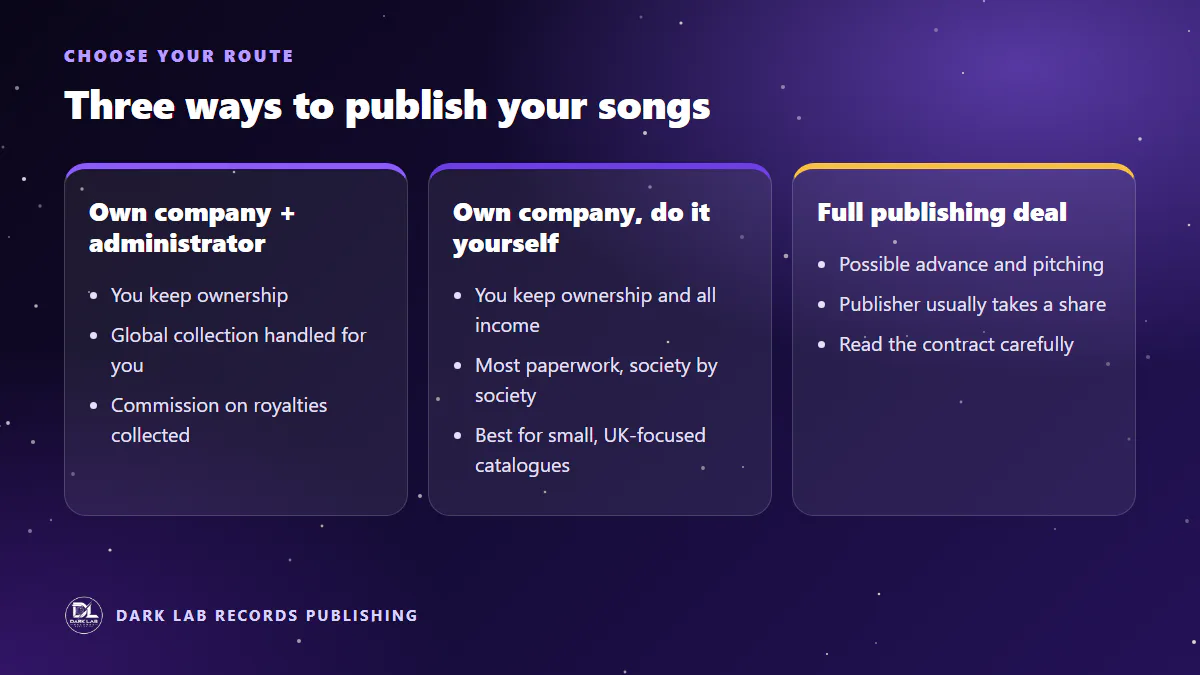
Not always. If you are early in your career and have few songs, the simplest route is to join a society as a writer and use a publishing administrator that collects the publisher's share for you. Starting your own company makes more sense when you have a growing catalogue, write with other writers, or want to sign other writers later. Read what a music publisher does to see which jobs you would be taking on.
Step 1: Choose your structure
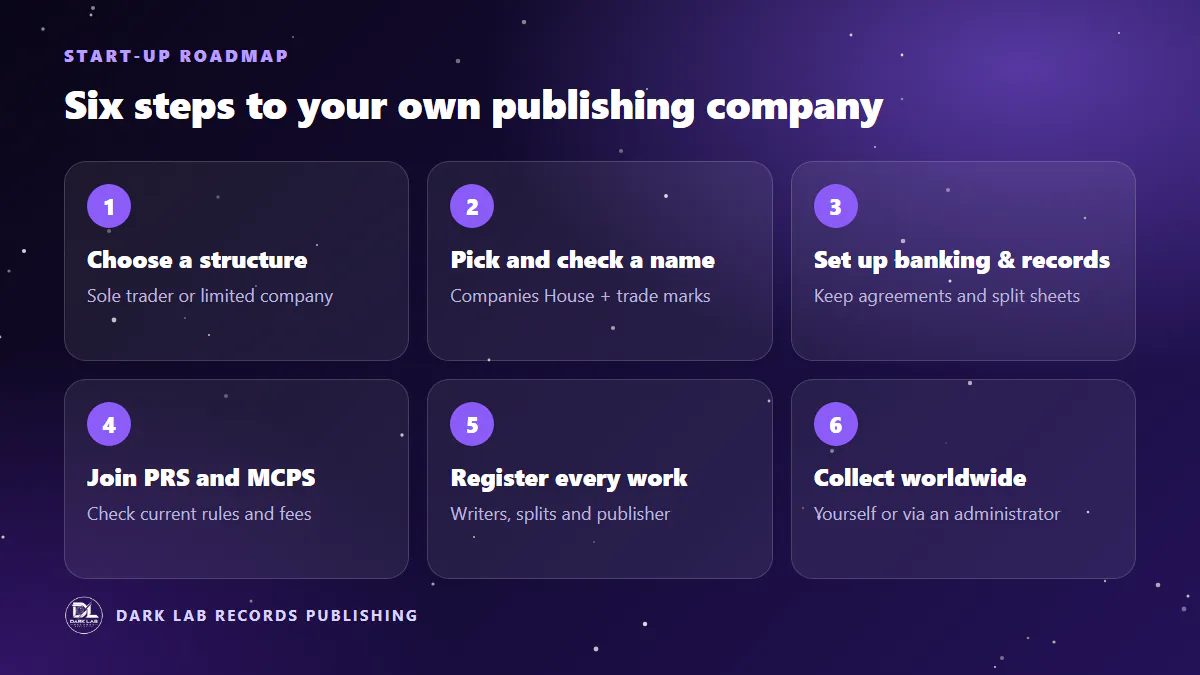
The common options are trading as a sole trader under a name, or forming a limited company. A limited company separates your personal and business finances but adds filing and accounting duties. You can read the official steps on GOV.UK. Because tax and liability depend on your own situation, speak to an accountant or solicitor before you decide.
Step 2: Choose and check a name
Pick a name that is distinctive and easy to spell, because it will appear on every registration and statement. Search the Companies House register, the trade mark register and the main streaming platforms to avoid clashes. Use the same spelling everywhere, because mismatched names are a common cause of unmatched royalties (see ISRC vs ISWC vs IPI).
Step 3: Set up your banking and records
Open a business bank account if you are a company, and keep income and expenses separate from personal spending. Keep copies of every agreement, split sheet and statement. Good records make it easy to prove ownership later, and an accountant will thank you at tax time.
Step 4: Join PRS for Music and MCPS
In the UK, songwriters join PRS for Music for performance royalties and apply for MCPS for mechanical royalties. Publishers can apply as publisher members. The conditions can include proof that you operate as a publisher, such as a publishing agreement, and a minimum catalogue. Fees and rules change, so check the current requirements on the PRS for Music website. If the conditions do not suit you yet, a publishing administrator can collect the publisher's share on your behalf in the meantime. Our guide to PRS vs MCPS vs PPL explains which organisation does what.
Step 5: Register every work properly
Membership does not register your songs. For each work, register the title, every writer, the splits and your publishing company as publisher. Use a written split sheet signed by the writers at the time of writing. Our step-by-step guide to registering a song covers the details.
Step 6: Decide how to collect worldwide
PRS for Music covers the UK and has links with societies abroad, but your songs may earn in many countries, each with its own societies and rules. You can join and manage those yourself, or appoint a publishing administrator to register and collect globally for a commission. A proper administration deal should not take ownership of your copyright. Compare your options in Songtrust vs Sentric vs TuneCore Publishing and learn about deal types in admin vs co-publishing vs full publishing.
Put the rights in writing
If you run a publishing company and write songs, the company needs the right to publish or administer them. That is normally a short written agreement between you as the writer and your company. It should say what rights the company holds, for how long, and how income is shared. When you co-write with other people, agree and sign split sheets, and make sure each writer's publishing arrangements are clear. Because these documents have legal and tax effects, have them reviewed by a music solicitor.
What does it cost, and how long does it take?
The main costs are company formation (if you form one), society membership fees, accountancy and the time spent registering songs. Society fees and eligibility rules change, so check the current figures with PRS for Music and MCPS. Registering a small catalogue takes hours. Registering a large back catalogue with correct splits can take weeks, which is one reason writers hand it to an administrator.
When signing with a publisher is the better choice
Running your own publishing keeps ownership and income with you, but it does not open doors. A traditional publisher can offer advances, introductions and sync pitching in return for a share of rights or income. If you need an advance or active pitching, a full deal may suit you, but read the contract carefully. Our guide to admin vs co-publishing vs full publishing explains the differences.
Common mistakes to avoid
- Registering as a writer only and never adding a publisher, so the publisher's share goes uncollected.
- No signed split sheet, which causes arguments and delays payment.
- Different spellings of your company name across societies and platforms.
- Assuming your distributor handles publishing. Distributors usually collect master income, not publishing.
- Signing an "administration" contract that quietly assigns copyright. Read the wording carefully.
How Dark Lab Records Publishing can help
Dark Lab Records Publishing is a UK-registered administrator with a team in London and Vancouver. You add your songs and writers in the dashboard and we register and administer them across 200+ territories. You keep 100% of your copyright, and you see earnings by song, platform and territory with exports to PDF, Excel or CSV. If you are building your own publishing company, we can handle the global administration so you can focus on writing. See our services, information for songwriters or get in touch.
Final thoughts
Starting a publishing company is less about size and more about being set up correctly: a clear identity, the right society memberships and properly registered works. Do those three things and you are positioned to collect both halves of every royalty your songs earn. Get proper advice on structure and tax, check each society's current rules, and decide whether you want to collect worldwide yourself or hand that work to an administrator.
Frequently asked questions
Do I need a limited company to start a music publishing company?
Not necessarily. Some writers trade under a name as a sole trader, others set up a limited company. The right structure depends on your income, liability and tax position, so take advice from an accountant or solicitor.
How much does it cost to set up a publishing company in the UK?
Costs include company formation if you choose a limited company, any society membership fees and accounting. Society fees and eligibility rules change, so check the current figures on PRS for Music and MCPS before budgeting.
Can I join PRS as a publisher without a company?
Eligibility rules are set by PRS for Music and can include proof that you act as a publisher, for example a publishing agreement, and a minimum catalogue size. Check the current requirements on its website, or use a publishing administrator to collect the publisher's share instead.
Is a publishing administrator an alternative to starting my own company?
They can work together. You can register your own publishing identity and still appoint an administrator to register and collect your royalties worldwide for a commission, while you keep ownership of your songs.
What is the difference between self-publishing and signing a publishing deal?
When you self-publish you own the publishing and collect the publisher's share yourself or through an administrator. In a full publishing deal a publisher usually takes a share of the rights or income in return for services and sometimes an advance.
Is this legal or tax advice?
No. This guide is general information. Speak to a qualified accountant or solicitor about company structure, tax and contracts before you set anything up.
Written by
Dark Lab Records Publishing
Practical guidance on music publishing, royalties and rights from the Dark Lab Records Publishing team.